QRA
Numbers that withstand regulatory and insurer scrutiny — individual risk, societal risk, F-N curves.
Full quantitative risk assessment including dispersion, fire and explosion modelling, individual and societal risk contours.
Request a Consultation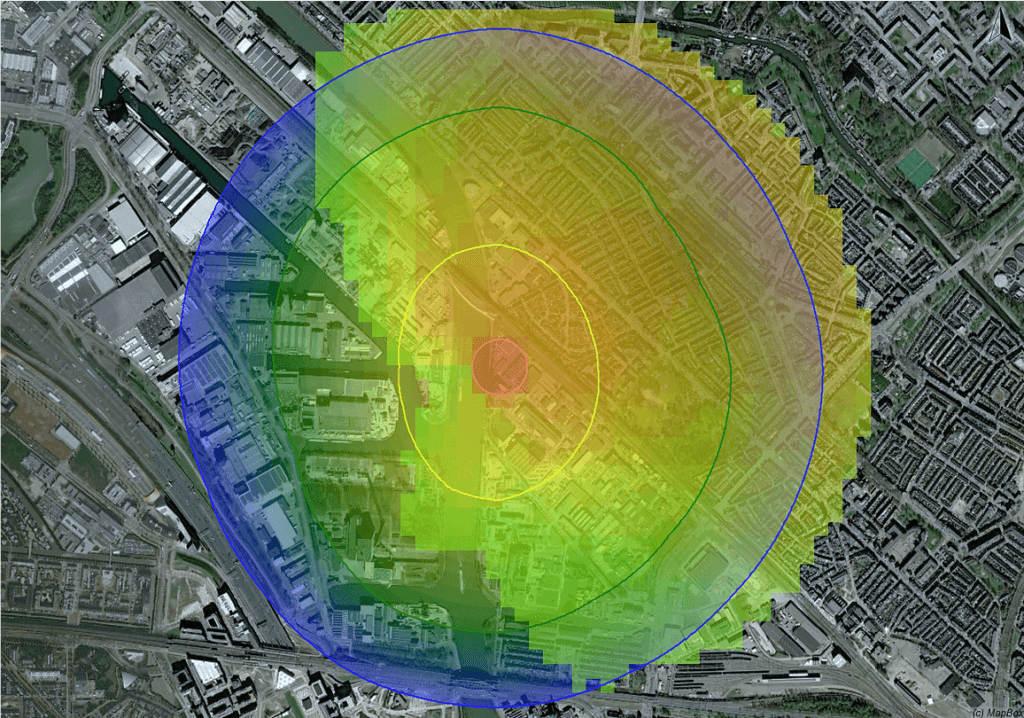
What is QRA?
Quantitative Risk Assessment (QRA) is a rigorous, numerical methodology for estimating the risk to people, assets and the environment posed by major accident hazard scenarios. QRA combines failure frequency data, consequence modelling (dispersion, fire, explosion, toxic effects) and population/exposure data to generate individual risk contours, societal risk (F-N curves), and risk ranking against tolerability criteria such as ALARP.
Why It Matters
- ●Required for land-use planning approval near Major Accident Hazard (MAH) installations
- ●Demonstrates ALARP (As Low As Reasonably Practicable) to regulators and insurers
- ●Informs emergency response planning radii and mutual aid arrangements
- ●Provides defensible basis for siting decisions and risk-cost trade-off justification
Our Methodology
- 1Hazard inventory and representative leak/release scenario selection
- 2Frequency analysis using fault tree and recognised failure rate databases
- 3Consequence modelling — dispersion, pool fire, jet fire, flash fire, VCE, BLEVE as applicable
- 4Risk integration to generate individual risk contours and societal risk F-N curves
- 5ALARP demonstration and risk reduction recommendation
Deliverables
Industries We Serve
FAQ
QRA Frequently Asked Questions
What is QRA in process safety?
QRA (Quantitative Risk Assessment) is a numerical risk assessment method that combines failure frequencies with consequence modelling of fire, explosion and toxic dispersion scenarios to calculate individual and societal risk levels for a facility.
What is ALARP?
ALARP (As Low As Reasonably Practicable) is a risk management principle stating that risk should be reduced until the cost of further reduction is grossly disproportionate to the benefit gained, used as the tolerability test in QRA studies.
What outputs does a QRA produce?
A QRA typically produces individual risk contour plots overlaid on the site plan, societal risk F-N curves, ranked contributing scenarios, and recommendations for risk reduction measures where risk exceeds tolerability criteria.